
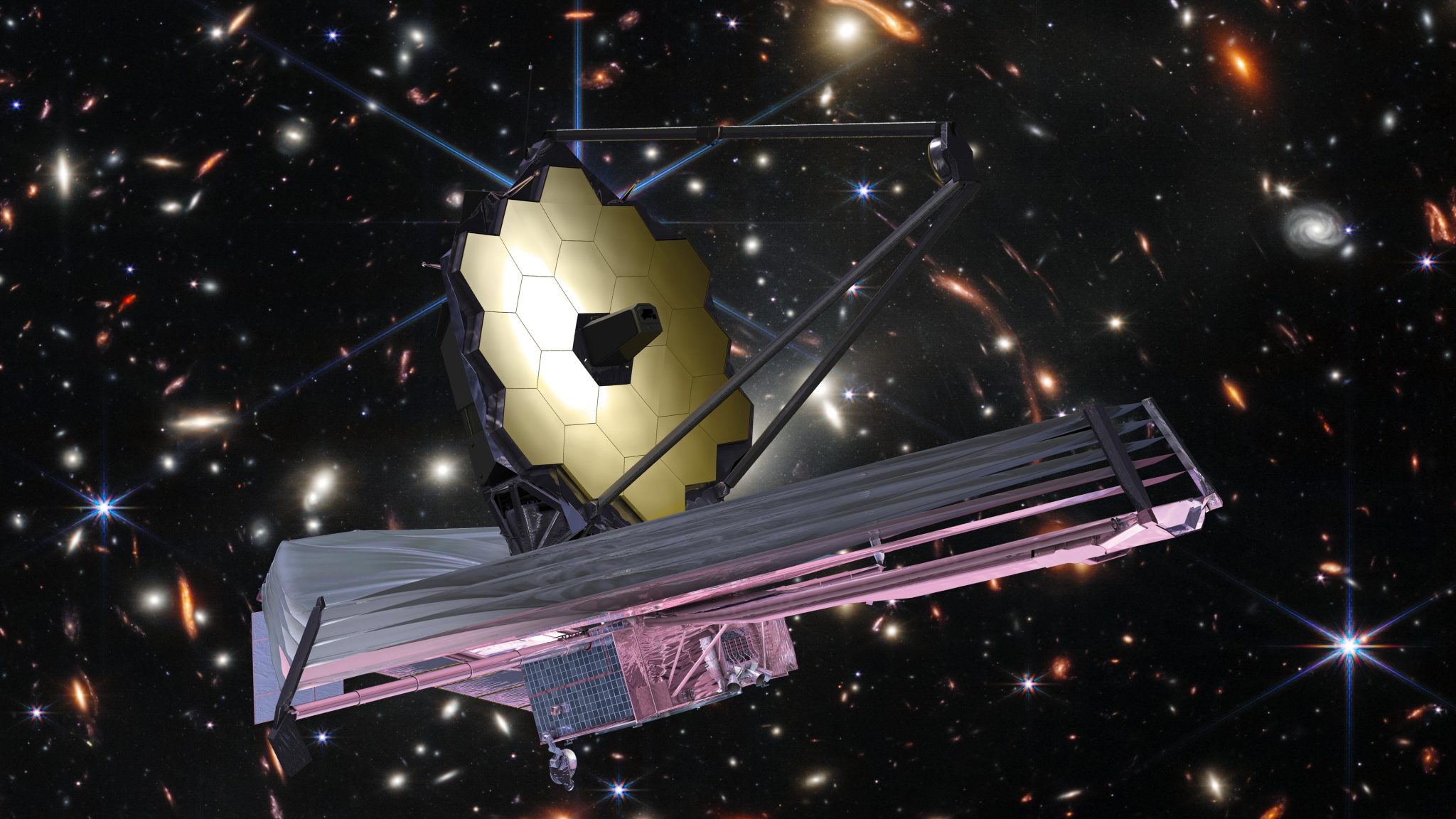
망원경으로 관측한 최초의 은하계인 은하단 SMACS 0723 앞의 제임스 웹. James Webb Space Telescope의 초기 결과는 현재의 우주 모델을 무시하는 놀랍도록 큰 초기 은하를 보여주었습니다. 크레딧: NASA, ESA, CSA, STScI
의 첫 번째 결과[{” attribute=””>James Webb Space Telescope have hinted at galaxies so early and so massive that they are in tension with our understanding of the formation of structure in the Universe. Various explanations have been proposed that may alleviate this tension. But now a new study from the Cosmic Dawn Center suggests an effect that has never before been studied at such early epochs, indicating that the galaxies may be even more massive.
If you have been following the first results from the James Webb Space Telescope, you have probably heard about the paramount issue with the observations of the earliest galaxies:
They are too big.
From a few days after the release of the first images, and repeatedly through the coming months, new reports of ever-more distant galaxies appeared. Disturbingly, several of the galaxies seemed to be “too massive.”
From our currently accepted concordance model of the structure and evolution of the Universe, the so-called ΛCDM model, they simply shouldn’t have had the time to form so many stars.
Although ΛCDM is not a holy indestructible grail, there are many reasons to wait before claiming a paradigm shift: The measured epochs at which we see the galaxies could be underestimated.
Their stellar masses could be overestimated. Or we could just have been lucky and somehow discovered the most massive of the galaxies at that time.
A closer look
But now Clara Giménez Arteaga, Ph.D. student at the Cosmic Dawn Center, proposes an effect that could further increase the tension:
In essence, a galaxy’s stellar mass is estimated by measuring the amount of light emitted by the galaxy, and calculating how many stars are needed to emit this amount. The usual approach is to consider the combined light from the whole galaxy.
However, taking a closer look at a sample of five galaxies, observed with James Webb, Giménez Arteaga found that if the galaxy is regarded not as one big blob of stars, but as an entity build up of multiple clumps, a different picture emerges.

Galaxy cluster SMACS This image of galaxy cluster SMACS 0723 and its surroundings was the first image released from the James Webb Space Telescope in July 2023. The five zoom-ins are each roughly 19,000 lightyears across, and show galaxies seen some 13 billion years back in time. Careful analysis of these galaxies reveals that if we cannot resolve a galaxy, we may severely underestimate the total mass of its stars. Image credit: NASA, ESA, CSA, STScI / Giménez-Arteaga et al. (2023), Peter Laursen (Cosmic Dawn Center).
“We used the standard procedure to calculate stellar masses from the images that James Webb has taken, but on a pixel-by-pixel basis rather than looking at the whole galaxy,” describes Giménez Arteaga.
“In principle, one might expect the results to be the same: Adding the light from all pixels and finding the total stellar mass, versus calculating the mass of each pixel and adding all individual stellar masses. But they’re not.”
In fact, the inferred stellar masses now turned out to be up to ten times larger.
The figure below shows the five galaxies with their stellar masses determined by both ways. If the two different approaches agreed, all galaxies would lie along the slanted line named “The same.” But they all lie above this line.
Outshined
So what is the reason that the stellar masses turn out to be so much larger?
Giménez Arteaga explains: “Stellar populations are a mixture of small and faint stars on one hand, and bright, massive stars on the other hand. If we just look at the combined light, the bright stars will tend to completely outshine the faint stars, leaving them unnoticed. Our analysis shows that bright, star-forming clumps may dominate the total light, but the bulk of the mass is found in smaller stars.”
Stellar mass is one of the main properties used to characterize a galaxy, and Giménez-Arteaga’s result highlights the importance of being able to resolve the galaxies.
But for the most distant and faint ones, this is not always possible. The effect has been studied before, but only at much later epochs in the history of the Universe.
The next step is therefore to look for signatures that does not require the high resolution, and which correlate with the “true” stellar mass.
“Other studies at much later epochs have also found this discrepancy. If we can determine how common and severe the effect is at earlier epochs, and quantify it, we will be closer to inferring robust stellar masses of distant galaxies, which is one of the main current challenges of studying galaxies in the early Universe,” concludes Clara Giménez Arteaga.
The study has just been published in the Astrophysical Journal.
Reference: “Spatially Resolved Properties of Galaxies at 5 < z < 9 in the SMACS 0723 JWST ERO Field” by Clara Giménez-Arteaga, Pascal A. Oesch, Gabriel B. Brammer, Francesco Valentino, Charlotte A. Mason, Andrea Weibel, Laia Barrufet, Seiji Fujimoto, Kasper E. Heintz, Erica J. Nelson, Victoria B. Strait, Katherine A. Suess and Justus Gibson, 16 May 2023, Astrophysical Journal.
DOI: 10.3847/1538-4357/acc5ea

김애란은 bsnewspaper.com의 필진으로 뉴스, 정치, 경제, 기술, 스포츠, 엔터테인먼트, 라이프스타일 등 다양한 분야의 소식을 다룹니다. 독자들이 중요한 이슈를 쉽게 이해할 수 있도록 명확하고 균형 잡힌 보도에 중점을 두고 있으며, 유용한 정보와 시의성 있는 내용을 전달합니다. 또한 현재의 주요 사건과 독자들의 관심사에 맞는 이야기를 알기 쉽게 풀어내는 데 힘쓰고 있습니다.