
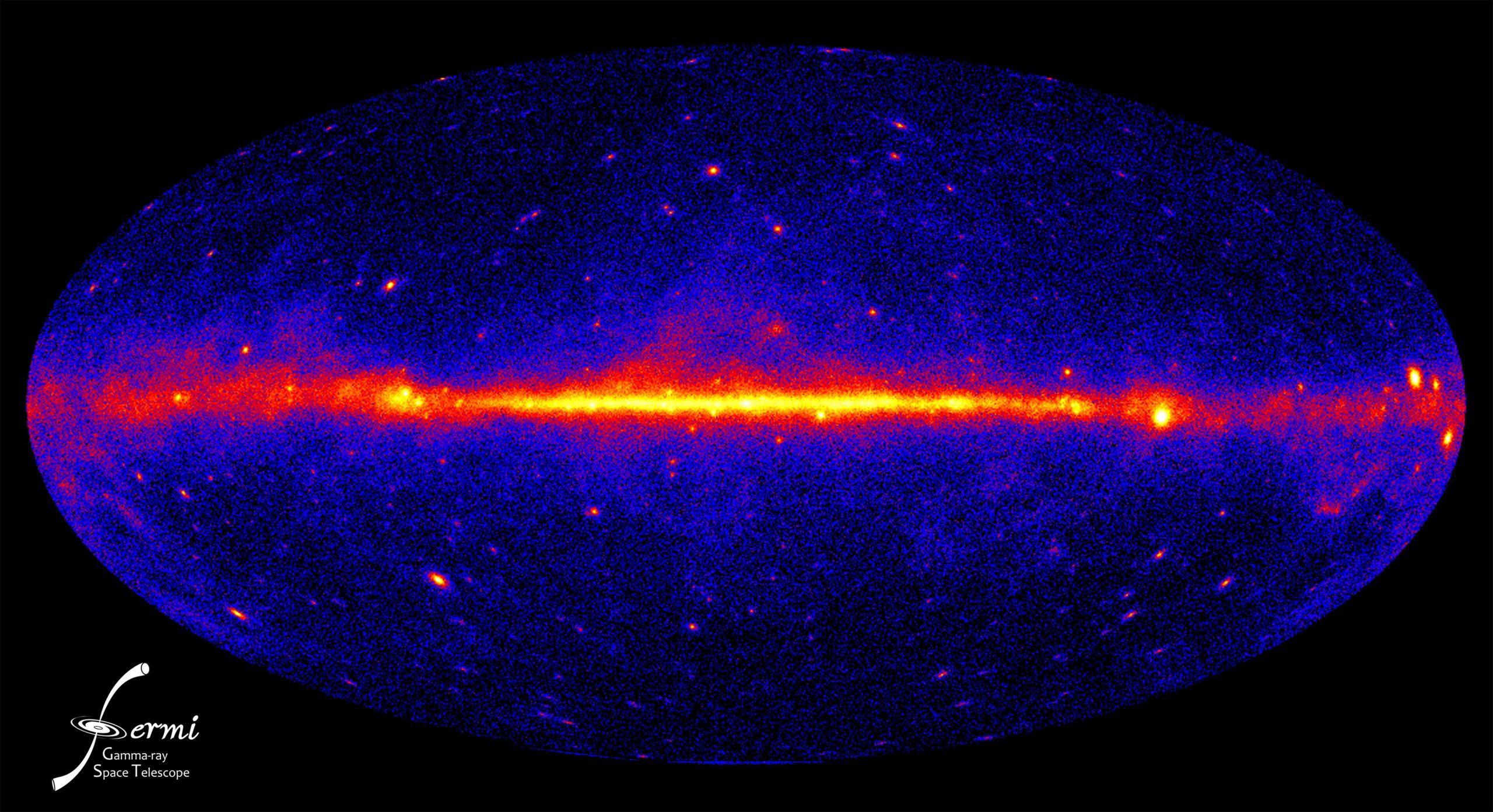
감마선 하늘의 보기입니다. 출처: NASA/DOE/Fermi LAT 협력
The 연구원[{” attribute=””>Australian National University (ANU) have found an alternative explanation for a mysterious gamma-ray signal coming from the center of the galaxy, which was long claimed as a signature of dark matter.
Gamma-rays are the form of electromagnetic radiation with the shortest wavelength and highest energy.
Co-author of the study Associate Professor Roland Crocker said this particular gamma-ray signal — known as the Galactic Center Excess — may actually come from a specific type of rapidly-rotating neutron star, the super-dense stellar remnants of some stars much more massive than our sun.
The Galactic Center Excess is an unexpected concentration of gamma-rays emerging from the center of our galaxy that has long puzzled astronomers.
“Our work does not throw any doubt on the existence of the signal, but offers another potential source,” Associate Professor Crocker said.
“It is based on millisecond pulsars — neutron stars that spin really quickly — around 100 times a second.
“Scientists have previously detected gamma-ray emissions from individual millisecond pulsars in the neighborhood of the solar system, so we know these objects emit gamma-rays. Our model demonstrates that the integrated emission from a whole population of such stars, around 100,000 in number, would produce a signal entirely compatible with the Galactic Center Excess.”
The discovery may mean scientists have to re-think where they look for clues about dark matter.
“The nature of dark matter is entirely unknown, so any potential clues garner a lot of excitement,” Associate Professor Crocker said.
“But our results point to another important source of gamma-ray production.
“For instance, the gamma-ray signal from Andromeda, the next closest large galaxy to our own may be mostly due to millisecond pulsars.”
ANU Masters student Anuj Gautam led the research, which also involved scientists from The Australian Defence Force Academy, University of Canterbury, and University of Tokyo.
The research has been published in the journal Nature Astronomy.
Reference: “Millisecond pulsars from accretion-induced collapse as the origin of the Galactic Centre gamma-ray excess signal” by Anuj Gautam, Roland M. Crocker, Lilia Ferrario, Ashley J. Ruiter, Harrison Ploeg, Chris Gordon and Oscar Macias, 28 April 2022, Nature Astronomy.
DOI: 10.1038/s41550-022-01658-3

김애란은 bsnewspaper.com의 필진으로 뉴스, 정치, 경제, 기술, 스포츠, 엔터테인먼트, 라이프스타일 등 다양한 분야의 소식을 다룹니다. 독자들이 중요한 이슈를 쉽게 이해할 수 있도록 명확하고 균형 잡힌 보도에 중점을 두고 있으며, 유용한 정보와 시의성 있는 내용을 전달합니다. 또한 현재의 주요 사건과 독자들의 관심사에 맞는 이야기를 알기 쉽게 풀어내는 데 힘쓰고 있습니다.