
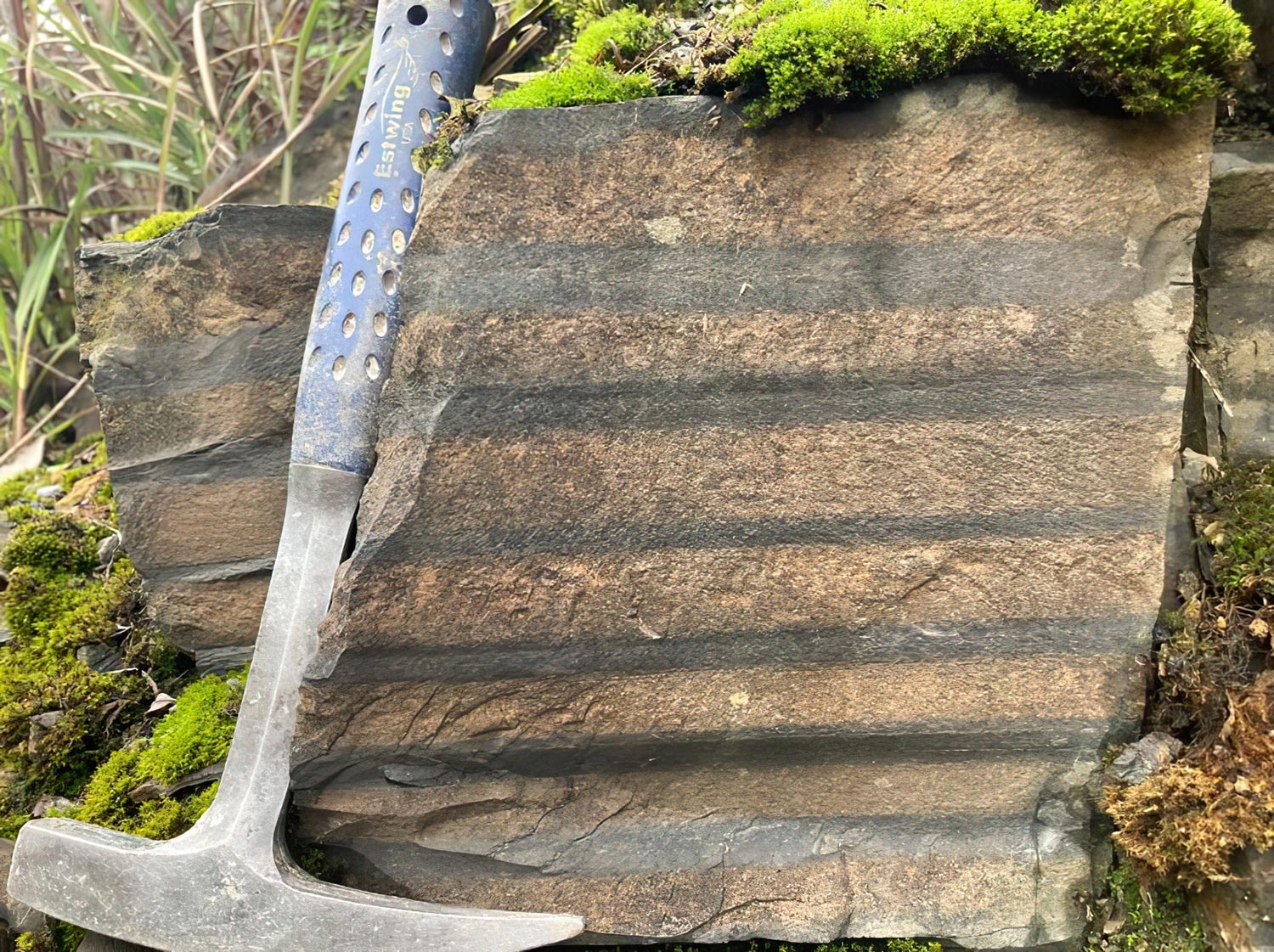
밀란코비치 주기를 보존하는 6억년 된 퇴적암을 통해 고대 지구의 하루 길이를 발견할 수 있습니다. 신용: 로스 미첼
네이처(Nature) 저널에 발표된 연구에 따르면 전통적인 믿음과 달리 과거에 지구의 하루 길이는 꾸준히 짧아진 것이 아니라 약 10억 년 동안 약 19시간에서 멈췄을 수도 있다고 합니다. It’s tough accomplishing everything we want to get done in a day. But it would have been even more difficult had we lived earlier in Earth’s history.
Although we take the 24-hour day for granted, in Earth’s deep past, days were even shorter.
Day length was shorter because the Moon was closer. “Over time, the Moon has stolen Earth’s rotational energy to boost it into a higher orbit farther from Earth,” said Ross Mitchell, geophysicist at the Institute of Geology and Geophysics of the Chinese Academy of Sciences and lead author of a new study published in Nature Geoscience.
“Most models of Earth’s rotation predict that day length was consistently shorter and shorter going back in time,” said Uwe Kirscher, co-author of the study and a research fellow now at Curtin University in Australia.
But a slow and steady change in day length going back in time is not what Mitchell and Kirscher found.

Illustration of Earth’s opposing tides from the pull of the Moon and the push of the Sun. Credit: Mitchell, et al.
How do researchers measure ancient day length? In past decades, geologists used records from special sedimentary rocks preserving very fine-scale layering in tidal mud flats. Count the number of sedimentary layers per month caused by tidal fluctuations and you know the number of hours in an ancient day.
But such tidal records are rare, and those preserved are often disputed. Luckily, there’s another means of estimating day length.
Cyclostratigraphy is a geologic method that uses rhythmic sedimentary layering to detect astronomical “Milankovitch” cycles that reflect how changes in Earth’s orbit and rotation affect climate.
“Two Milankovitch cycles, precession and obliquity, are related to the wobble and tilt of Earth’s rotation axis in space. The faster rotation of early Earth can therefore be detected in shorter precession and obliquity cycles in the past,” explained Kirscher.
Mitchell and Kirscher took advantage of a recent proliferation of Milankovitch records, with over half of the data for ancient times generated in the past seven years.
“We realized that it was finally time to test a kind of fringe, but completely reasonable, alternative idea about Earth’s paleorotation,” said Mitchell.
One unproven theory is that day length might have stalled at a constant value in Earth’s distant past. In addition to tides in the ocean related to the pull of the Moon, Earth also has solar tides related to the atmosphere heating up during daytime.
Solar atmospheric tides are not as strong as lunar oceanic tides, but this would not always have been the case. When Earth was rotating faster in the past, the tug of the Moon would have been much weaker. Unlike the pull of the Moon, the Sun’s tide instead pushes Earth. So while the Moon slows Earth’s rotation down, the Sun speeds it up.
“Because of this, if in the past these two opposite forces were to have become been equal to each other, such a tidal resonance would have caused Earth’s day length to stop changing and to have remained constant for some time,” said Kirscher.
And that’s exactly what the new data compilation showed.
Earth’s day length appears to have stopped its long-term increase and flatlined at about 19 hours roughly between two to one billion years ago—”the billion years,” Mitchell noted, “commonly referred to as the ‘boring’ billion.”
The timing of the stalling intriguingly lies between the two largest rises in oxygen. Timothy Lyons of the University California, Riverside, who was not involved in the study, said, “It’s fascinating to think that the evolution of the Earth’s rotation could have affected the evolving composition of the atmosphere.”
The new study thus supports the idea that Earth’s rise to modern oxygen levels had to wait for longer days for photosynthetic bacteria to generate more oxygen each day.
Reference: “Mid-Proterozoic day length stalled by tidal resonance” by Ross N. Mitchell and Uwe Kirscher, 12 June 2023, Nature Geoscience.
DOI: 10.1038/s41561-023-01202-6

김애란은 bsnewspaper.com의 필진으로 뉴스, 정치, 경제, 기술, 스포츠, 엔터테인먼트, 라이프스타일 등 다양한 분야의 소식을 다룹니다. 독자들이 중요한 이슈를 쉽게 이해할 수 있도록 명확하고 균형 잡힌 보도에 중점을 두고 있으며, 유용한 정보와 시의성 있는 내용을 전달합니다. 또한 현재의 주요 사건과 독자들의 관심사에 맞는 이야기를 알기 쉽게 풀어내는 데 힘쓰고 있습니다.