
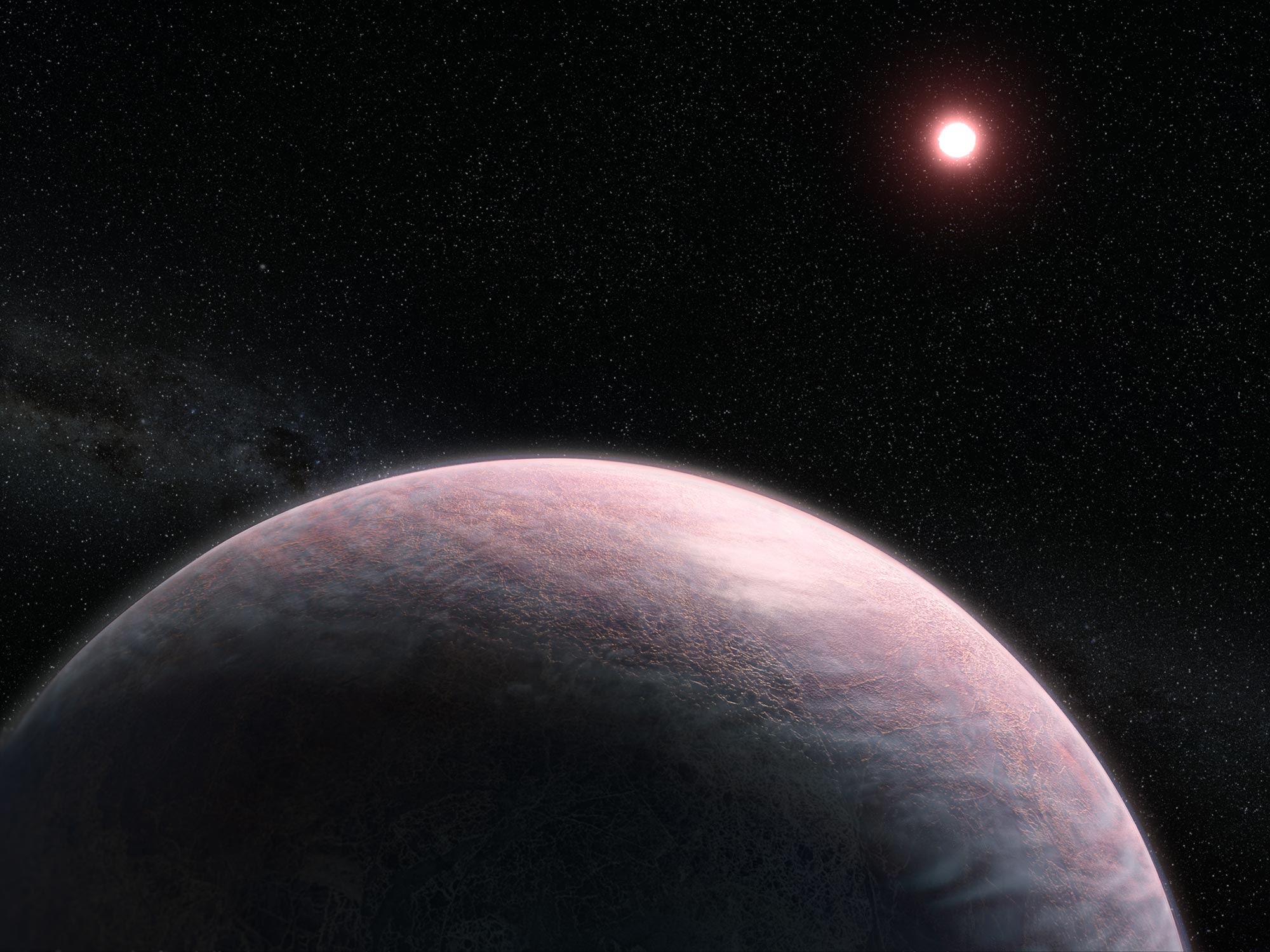
이 작가의 인상은 적색 왜성을 도는 흐리고 고요한 분위기의 암석 외계 행성을 보여줍니다. 크레딧: L. Hustak 및 J. Olmsted(STScI)
그만큼[{” attribute=””>James Webb Space Telescope (JWST), launched last December, has been slowly powering up its instruments and unfurling its sunshield, and is now in the process of aligning its mirrors in preparation for operation. Within a few months, the most powerful space telescope ever built is going to set its sights on the stars. Astronomers are hoping that what JWST sees will change the way we understand our universe, just as the Hubble Space Telescope did decades before.
One tantalizing capability that JWST offers that Hubble could not is the opportunity to directly image planets orbiting distant stars, and maybe, just maybe, detect signs of life.
The possibility of remotely detecting biosignatures has been a hot topic in recent years. In our own solar system, the recent discovery of phosphine in Venus’ atmosphere sparked speculation that the chemical might be created by a microbial lifeform. Similarly, remote sensing experts have proposed that plant life – which uses photosynthesis for energy – could be detected in infrared wavelengths, as chlorophyll absorbs visible light, but shows up brightly in infrared, and would give planets covered in foliage a distinct ‘red edge‘. A single-pixel photo of a distant planet just might contain enough information to tell us if biological life is there, based on the information stored in the wavelengths of light that reach the telescope lens.

An artist’s impression of the James Webb Space Telescope, fully deployed. The James Webb Space Telescope is expected to be fully operational this summer. Credit: NASA
But what about intelligent life? Could JWST detect civilizations similar to ours? How would we look for them? The best answers come from understanding what humanity’s presence on Earth looks like from outer space. We give off waste heat (from industry and homes and so on) and artificial light at night, but perhaps most significantly, we produce chemicals that fill our atmosphere with compounds that wouldn’t otherwise be present. These artificial atmospheric constituents just might be the thing that gives us away to a distant alien species scanning the galaxy with their own powerful telescope.
A recent paper – available in preprint on ArXiv – examined the possibility of using JWST to search for industrial pollutants in the atmospheres of exoplanets. The paper focused specifically on chlorofluorocarbons (CFCs), which, on Earth, are produced industrially as refrigerants and cleaning agents. CFC’s infamously created a massive hole in Earth’s ozone layer in the 1980s, before an international ban on their use in 1987 helped reduce the level of CFCs back to less harmful levels. These “potent greenhouse agents with long atmospheric residence times,” if found elsewhere in the galaxy, are almost certain to be the result of a civilization capable of rampant industrialization.
In other words, some of humanity’s worst byproducts – our pollution – may be the very things that make us detectable. And it means that we may be able to find other species capable of treating their own planet’s atmosphere with the same disregard.
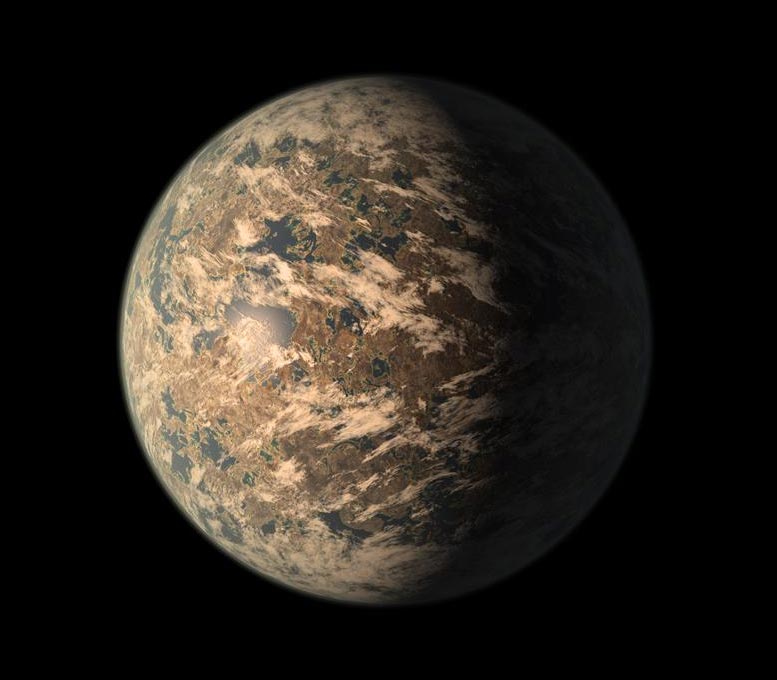
An artist’s rendition of TRAPPIST-1e, a potentially habitable, Earth-sized planet circling a red dwarf 40 light-years away. Credit: NASA/JPL-Caltech
There are some limitations to JWST’s CFC finding capabilities. If a planet’s star is too bright, it will drown out the signal. The telescope will therefore have the most success by looking at M-class stars, which are dim, long-lived red dwarfs. A nearby example is TRAPPIST-1, a red dwarf 40 light-years away, with several Earth-sized planets orbiting within its habitable zone. JWST would be able to see CFCs on TRAPPIST-1’s planets, because the dim star won’t drown out the CFC signature in the same way that a bright star, like our Sun (a G-type star), would.
Conversely, a JWST-like telescope at TRAPPIST-1 wouldn’t be able to see Earth’s CFCs: our Sun is just too bright.
Unfortunately, M-class stars are not usually conducive to life, because when they are young, they are unstable, sending out powerful solar flares that might just exterminate any nascent life on nearby planets. They do, however, tend to calm down as they age, so it isn’t an impossibility. It just means that we should temper our expectations a bit.
Whatever we find, or don’t find, out there, the fact that we are about to have the capability to look at all is a game-changer. As the paper concludes, “with the launch of JWST, humanity may be very close to an important milestone in SETI [the Search for Extra-Terrestrial Intelligence]: 우리 자신과 같은 강하고, 의도적이며, 일시적이고, 고도로 지향적인 이동뿐만 아니라 근처의 별에서 감지할 수 있는 것입니다(예: 아레시보 . 메시지), 그러나 일관된 부정적인 기술적 지문은 우리의 지문만큼 강력합니다.”
참조: Jacob Haq-Misra, Ravi Kopparabu, Thomas J. Fushes, Adam Frank, Jason T Wright 및 Manasvi Lingam의 “거주 가능한 M형 왜성 행성의 대기에서 CFC의 발견 가능성”, 2022년 2월 11일, 천체물리학 > 지구와 행성의 천체물리학.
아르시브: 2202.05858
원래 게시 위치 오늘의 우주.

김애란은 bsnewspaper.com의 필진으로 뉴스, 정치, 경제, 기술, 스포츠, 엔터테인먼트, 라이프스타일 등 다양한 분야의 소식을 다룹니다. 독자들이 중요한 이슈를 쉽게 이해할 수 있도록 명확하고 균형 잡힌 보도에 중점을 두고 있으며, 유용한 정보와 시의성 있는 내용을 전달합니다. 또한 현재의 주요 사건과 독자들의 관심사에 맞는 이야기를 알기 쉽게 풀어내는 데 힘쓰고 있습니다.