
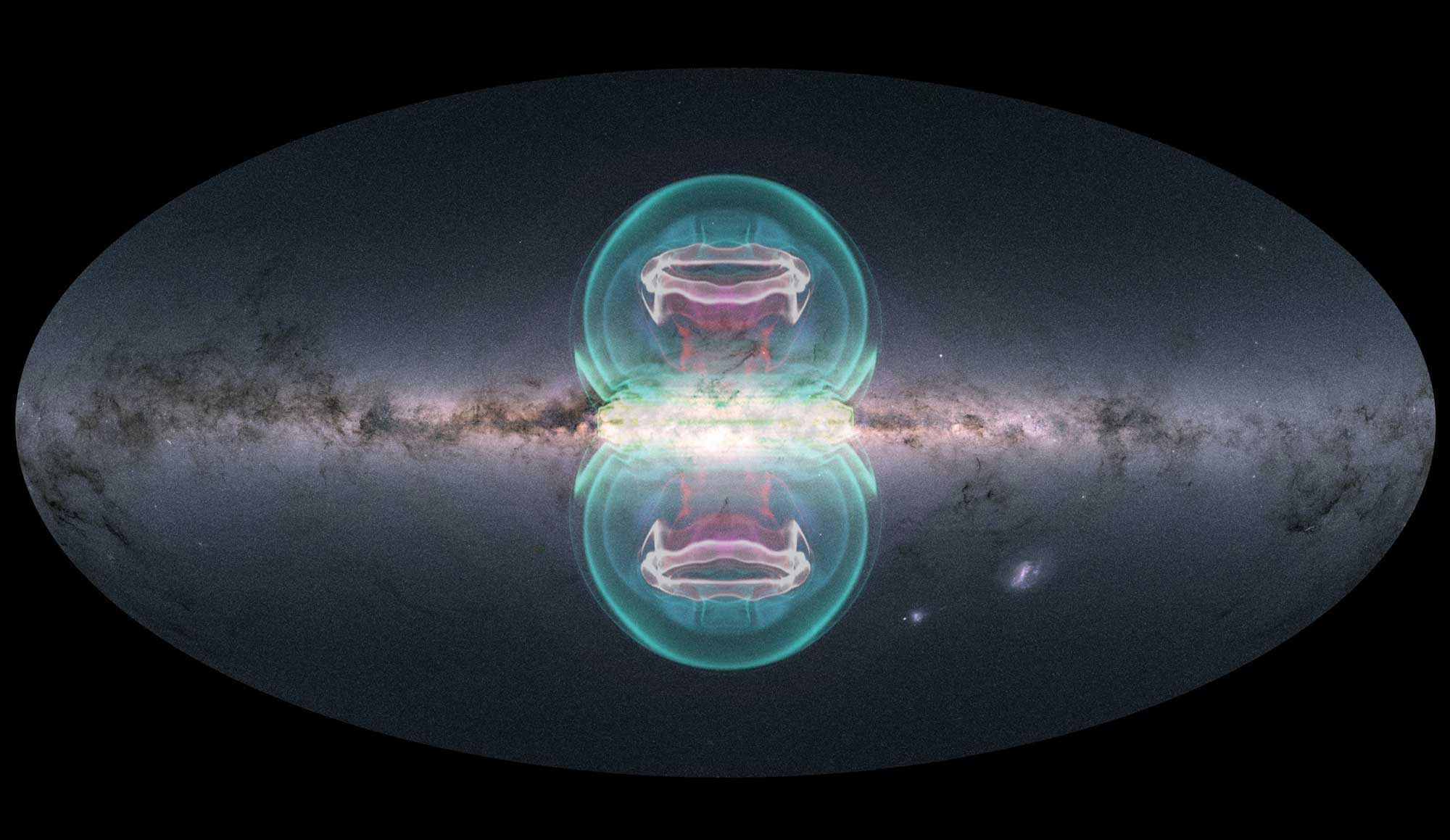
유럽 우주국의 가이아 우주 관측소에서 촬영한 은하수 이미지의 오버레이는 E 로제타 및 페르미 거품 시뮬레이션을 위해 시각화되었습니다. 에 발표된 새로운 연구 자연 천문학 은하수 중심 위아래로 확장되는 고에너지 가스의 거대한 구조인 eRosita 기포의 특성에 대한 자세한 정보를 제공합니다. 출처: ESA/Gaia/DPAC
고대 데이터에 대한 새로운 시각은 은하 형성에 대한 새로운 세부 사항을 보여줍니다.
천문학자들은 eRosita 기포와 고에너지 가스 구조가[{” attribute=””>Milky Way, are more complex and not hotter than surrounding areas, contrary to previous assumptions. Their analysis of Suzaku satellite data suggests the bubbles originate from nuclear star-forming activity rather than a supermassive black hole.
Astronomers have revealed new evidence about the properties of the giant bubbles of high-energy gas that extend far above and below the Milky Way galaxy’s center.
In a study recently published in Nature Astronomy, a team led by scientists at The Ohio State University was able to show that the shells of these structures – dubbed “eRosita bubbles” after being found by the eRosita X-ray telescope – are more complex than previously thought.
Although they bear a striking similarity in shape to Fermi bubbles, eRosita bubbles are larger and more energetic than their counterparts. Known together as the “galactic bubbles” due to their size and location, they provide an exciting opportunity to study star formation history as well as reveal new clues about how the Milky Way came to be, said Anjali Gupta, lead author of the study and a former postdoctoral researcher at Ohio State who is now a professor of astronomy at Columbus State Community College.
These bubbles exist in the gas that surrounds galaxies, an area that is called the circumgalactic medium.
“Our goal was really to learn more about the circumgalactic medium, a place very important in understanding how our galaxy formed and evolved,” Gupta said. “A lot of the regions that we were studying happened to be in the region of the bubbles, so we wanted to see how different the bubbles are when compared to the regions which are away from the bubble.”
Previous studies had assumed that these bubbles were heated by the shock of gas as it blows outward from the galaxy, but this paper’s main findings suggest the temperature of the gas within the bubbles isn’t significantly different from the area outside of it.
“We were surprised to find that the temperature of the bubble region and out of the bubble region were the same,” said Gupta. Additionally, the study demonstrates that these bubbles are so bright because they’re filled with extremely dense gas, not because they are at hotter temperatures than the surrounding environment.
Gupta and Smita Mathur, co-author of the study and a professor of astronomy at Ohio State, did their analysis using observations made by the Suzaku satellite, a collaborative mission between NASA and the Japanese Aerospace Exploration Agency (JAXA).
By analyzing 230 archival observations made between 2005 and 2014, researchers were able to characterize the diffuse emission – the electromagnetic radiation from very low-density gas – of the galactic bubbles, as well as the other hot gases that surround them.
Although the origin of these bubbles has been debated in scientific literature, this study is the first that begins to settle it, said Mathur. As the team found an abundance of non-solar neon-oxygen and magnesium-oxygen ratios in the shells, their results strongly suggest that galactic bubbles were originally formed by nuclear star-forming activity, or the injection of energy by massive stars and other kinds of astrophysical phenomena, rather than through the activities of a supermassive black hole.
“Our data supports the theory that these bubbles are most likely formed due to intense star formation activity at the galactic center, as opposed to black hole activity occurring at the galactic center,” Mathur said. To further investigate the implications their discovery may have for other aspects of astronomy, the team hopes to use new data from other upcoming space missions to continue characterizing the properties of these bubbles, as well as work on novel ways to analyze the data they already have.
“Scientists really do need to understand the formation of the bubble structure, so by using different techniques to better our models, we’ll be able to better constrain the temperature and the emission measures that we are looking for,” said Gupta.
Reference: “Thermal and chemical properties of the eROSITA bubbles from Suzaku observations” by Anjali Gupta, Smita Mathur, Joshua Kingsbury, Sanskriti Das and Yair Krongold,1 May 2023, Nature Astronomy.
DOI: 10.1038/s41550-023-01963-5
Other co-authors were Joshua Kingsbury and Sanskriti Das of Ohio State and Yair Krongold of the National Autonomous University of Mexico. This work was supported by NASA.

김애란은 bsnewspaper.com의 필진으로 뉴스, 정치, 경제, 기술, 스포츠, 엔터테인먼트, 라이프스타일 등 다양한 분야의 소식을 다룹니다. 독자들이 중요한 이슈를 쉽게 이해할 수 있도록 명확하고 균형 잡힌 보도에 중점을 두고 있으며, 유용한 정보와 시의성 있는 내용을 전달합니다. 또한 현재의 주요 사건과 독자들의 관심사에 맞는 이야기를 알기 쉽게 풀어내는 데 힘쓰고 있습니다.