
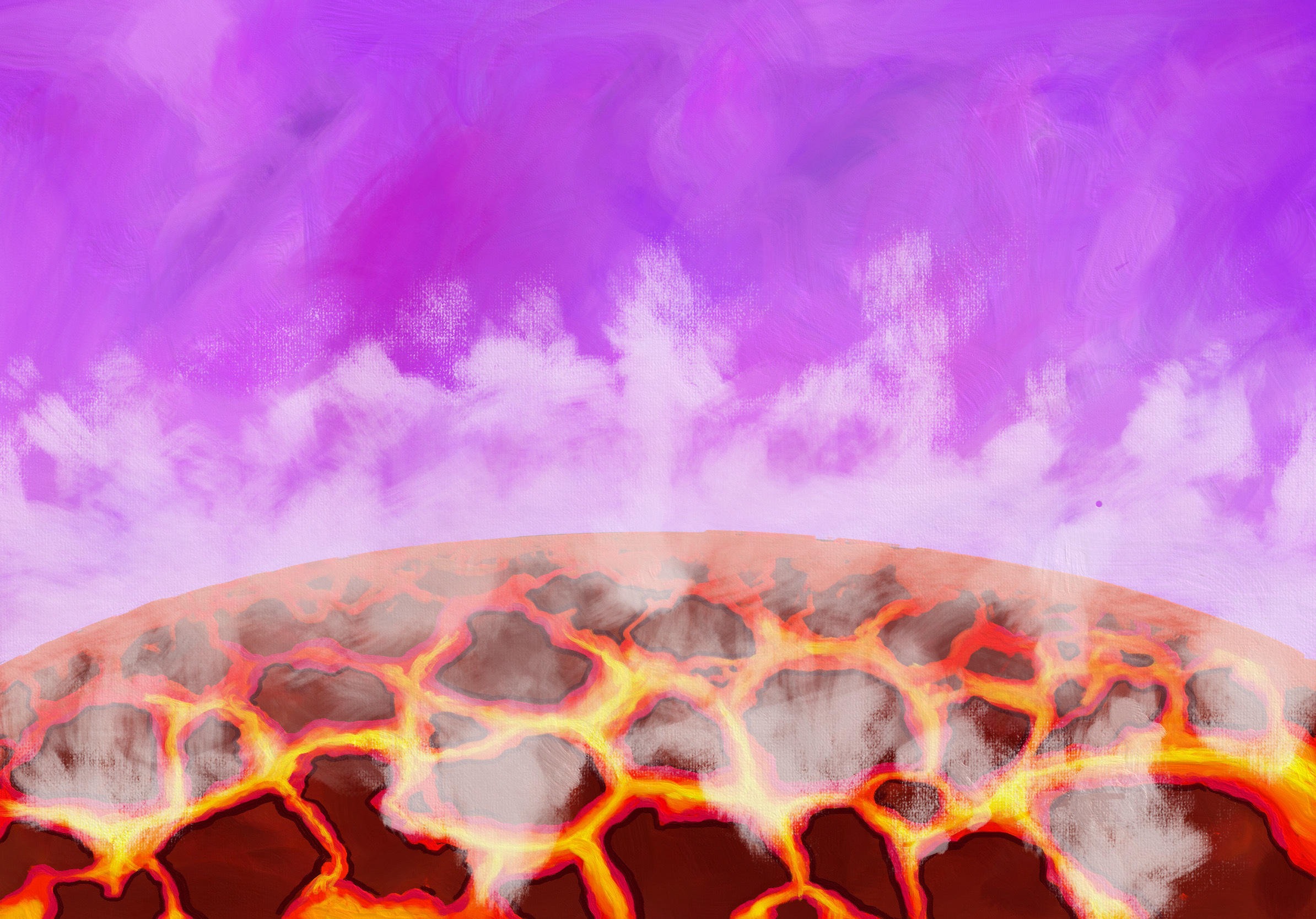
수증기를 형성하기 위해 대기와 상호 작용하는 젊은 행성의 용융 표면에 대한 예술적 인상. 크레딧: 키무라 타다히로
해변에서의 하루는 다른 행성에서의 일생입니다.
새로운 시뮬레이션에 따르면, 바다와 대륙이 있는 완벽하게 지구와 같은 외계행성뿐만 아니라 국경을 따라 있는 해변이 이전에 생각했던 것보다 적색 왜성 주변에서 더 흔할 수 있습니다. 이것은 현재와 미래의 10년이 끝날 때까지[{” attribute=””>exoplanet survey missions can expect to discover several Earth analogs for further investigation.
The range of orbits around a star where the temperature would be suitable for an exoplanet to have liquid water on its surface is referred to as the “habitable zone.” This does not imply that there is life or even water on the planet. In reality, life on the majority of exoplanets in the habitable zone would not be “a day at the beach.”
On Earth, both the oceans and continents play critical roles in the geochemical carbon cycle, which helps to sustain a temperate climate with liquid water and life. So, in order to search for potentially habitable Earth-like planets, we need “a day at the beach,” where land and sea can coexist.
Previous research has cautioned that such beach-friendly worlds may be extremely rare, even in the habitable zones around the most common types of stars (namely red dwarfs). This is due to a significant difference in the water content of rocky materials found in the inner and outer parts of a protoplanetary disk where planets form, resulting in the creation of planets with either too much or too little water in most situations.
But new numerical simulations conducted by Tadahiro Kimura from the University of Tokyo and Masahiro Ikoma from the National Astronomical Observatory of Japan provide a sunnier view. By taking into consideration water produced from interactions between the still-molten surface of a young planet and its primordial atmosphere, the team found that a wide range in final water content is expected.
And within that range, several percent of roughly-Earth-sized planets in habitable zones should have appropriate amounts of water for a temperate climate. This is a high enough percentage that ongoing and future exoplanet survey missions like TESS and PLATO can expect to find multiple examples of truly Earth-like exoplanets with beaches in the 2020s.
Reference: “Predicted diversity in water content of terrestrial exoplanets orbiting M dwarfs” by Tadahiro Kimura and Masahiro Ikoma, 29 September 2022, Nature Astronomy.
DOI: 10.1038/s41550-022-01781-1
The study was funded by the Japan Society for the Promotion of Science.

김애란은 bsnewspaper.com의 필진으로 뉴스, 정치, 경제, 기술, 스포츠, 엔터테인먼트, 라이프스타일 등 다양한 분야의 소식을 다룹니다. 독자들이 중요한 이슈를 쉽게 이해할 수 있도록 명확하고 균형 잡힌 보도에 중점을 두고 있으며, 유용한 정보와 시의성 있는 내용을 전달합니다. 또한 현재의 주요 사건과 독자들의 관심사에 맞는 이야기를 알기 쉽게 풀어내는 데 힘쓰고 있습니다.