
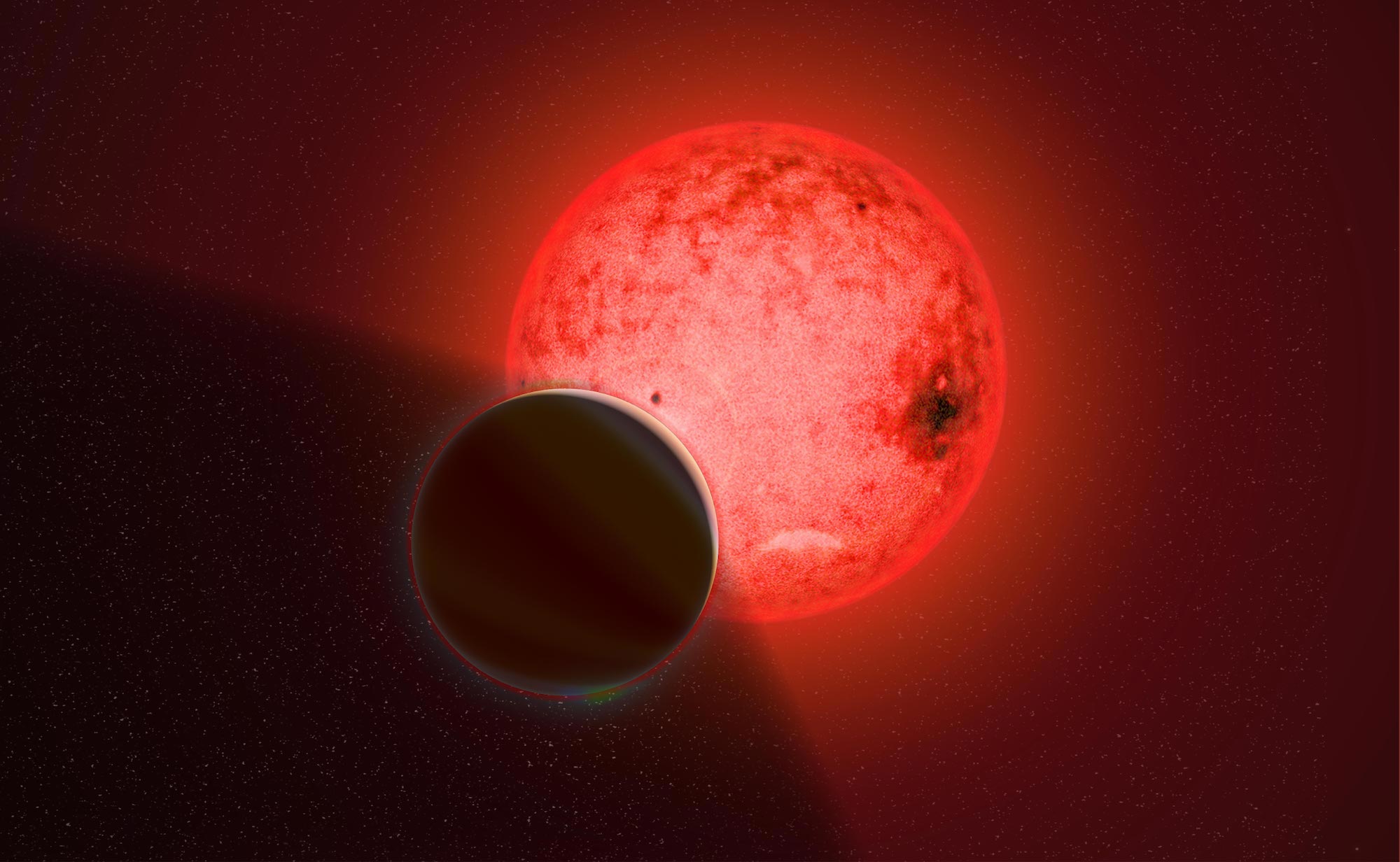
TOI-5205라고 불리는 작은 적색 왜성 주위를 공전하는 거대 가스 거대 행성에 대한 예술가의 개념. 출처: 사진: Catherine Cain, Carnegie Institution for Science 제공
작은 별 주위를 공전하는 “금지된” 행성이 가스 거성 형성 이론에 도전하다
행성 형성에 대한 우리의 현재 이해를 바탕으로 TOI-5205b는 존재하지 않아야 합니다. 그것은 “금지된” 행성입니다.
천문학자 팀이 TOI-5205라고 불리는 작은 적색 왜성 주위를 공전하는 거대 가스 거대 행성이 있는 특이한 행성계를 발견했습니다. 그들의 발견은 행성 형성에 대한 고대의 생각에 도전합니다. Carnegie Institution for Science의 Shubham Kanodia가 이끄는 연구원들은 연구 결과를 천문 저널.
태양보다 작고 온도가 낮은 M 왜성은 우리 우주에서 가장 흔한 별입니다.[{” attribute=””>Milky Way galaxy. Due to their small size, these stars tend to be about half as hot as the Sun and much redder. They have very low luminosities, but extremely long lifespans. Although red dwarfs host more planets, on average, than other, more massive types of stars, their formation histories make them unlikely candidates to host gas giants.

Artist’s conception of a large gas giant planet orbiting a small red dwarf star called TOI-5205. Until now no gas giant has been found in a planetary system around a low-mass M dwarf like TOI-5205. Credit: Image by Katherine Cain, courtesy of the Carnegie Institution for Science
The newly discovered planet—TOI 5205b—was first identified as a potential candidate by NASA’s Transiting Exoplanet Survey Satellite (TESS). Kanodia’s team, which included Carnegie’s Anjali Piette, Alan Boss, Johanna Teske, and John Chambers, then confirmed its planetary nature and characterized it using a variety of ground-based instruments and facilities.
“The host star, TOI-5205, is just about four times the size of Jupiter, yet it has somehow managed to form a Jupiter-sized planet, which is quite surprising!” exclaimed Kanodia, who specializes in studying these stars, which comprise nearly three-quarters of our galaxy yet can’t be seen with the naked eye. He also wrote a blog post about the discovery.
A small number of gas giants have been discovered orbiting older M dwarf stars. But until now no gas giant has been found in a planetary system around a low-mass M dwarf like TOI-5205. To grasp the size comparison here, a Jupiter-like planet orbiting a Sun-like star could be compared to a pea going around a grapefruit; for TOI-5205b, because the host star is so much smaller, it is more like a pea going around a lemon. In fact, when the Jupiter-mass TOI 5205b crosses in front of its host, it blocks about seven percent of its light—one of the largest known exoplanet transits.

A Jupiter-like planet orbiting a Sun-like star could be compared to a pea going around a grapefruit; for TOI-5205b, because the host star is so much smaller, it is more like a pea going around a lemon, said lead author Shubham Kanodia. Credit: Artwork by Katherine Cain is courtesy of the Carnegie Institution for Science
Planets are born in the rotating disk of gas and dust that surrounds young stars. The most commonly used theory of gas planet formation requires about 10 Earth masses of this rocky material to accumulate and form a massive rocky core, after which it rapidly sweeps up large amounts of gas from the neighboring regions of the disk to form the giant planet we see today.
The time frame in which this happens is crucial.
“TOI-5205b’s existence stretches what we know about the disks in which these planets are born,” Kanodia explained. “In the beginning, if there isn’t enough rocky material in the disk to form the initial core, then one cannot form a gas giant planet. And at the end, if the disk evaporates away before the massive core is formed, then one cannot form a gas giant planet. And yet TOI-5205b formed despite these guardrails. Based on our nominal current understanding of planet formation, TOI-5205b should not exist; it is a “forbidden” planet.”
The team demonstrated that the planet’s very large transit depth makes it extremely conducive for future observations with the recently launched JWST, which could shed some light on its atmosphere and offer some additional clues about the mystery of its formation.
Reference: “TOI-5205b: A Short-period Jovian Planet Transiting a Mid-M Dwarf” by Shubham Kanodia, Suvrath Mahadevan, Jessica Libby-Roberts, Gudmundur Stefansson, Caleb I. Cañas, Anjali A. A. Piette, Alan Boss, Johanna Teske, John Chambers, Greg Zeimann, Andrew Monson, Paul Robertson, Joe P. Ninan, Andrea S. J. Lin, Chad F. Bender, William D. Cochran, Scott A. Diddams, Arvind F. Gupta, Samuel Halverson, Suzanne Hawley, Henry A. Kobulnicky, Andrew J. Metcalf, Brock A. Parker, Luke Powers, Lawrence W. Ramsey, Arpita Roy, Christian Schwab, Tera N. Swaby, Ryan C. Terrien and John Wisniewski, 21 February 2023, The Astronomical Journal.
DOI: 10.3847/1538-3881/acabce
The TESS follow-up research was conducted using the Habitable-zone Planet Finder (HPF; Texas, US) and Low Resolution Spectrograph (LRS2; Texas, US) on the 10-m Hobby Eberly Telescope, the ARCTIC camera on the 3.5-m Apache Point Observatory (APO; New Mexico, US), the NN-Explore Exoplanet Stellar Speckle Imager (NESSI, Arizona, US) at the 3.5-m WIYN telescope, the 0.6-m Red Buttes Observatory (RBO, Wyoming, US), and the 0.3 m Three Hundred Millimeter Telescope (TMMT, Chile).
Other members of the research team were: Penn State University’s Suvrath Mahadevan, Jessica Libby-Roberts, Caleb Cañas (also of NASA Goddard Space Flight Center), Andrea Lin, Arvind Gupta, Luke Powers, and Lawrence Ramsey; Princeton University’s Gudmundur Stefansson; University of Texas Austin’s Greg Zeimann and William Cochran; University of Arizona’s Andrew Monson and Chad Bender; UC Irvine’s Paul Robertson; the Tata Institute of Fundamental Research’s Joe Ninan; University of Colorado Boulder’s Scott Diddams; the Jet Propulsion Laboratory’s Samuel Halverson; University of Washington’s Suzanne Hawley; University of Wyoming’s Henry Kobulnicky, Brock Parker, and Tera Swaby; the Air Force Research Laboratory’s Andrew Metcalf; the Space Telescope Science Institute’s Arpita Roy (also of Johns Hopkins University); Macquarie University’s Christian Schwab; Carleton College’s Ryan Terrien; and George Mason University’s John Wisniewski.

김애란은 bsnewspaper.com의 필진으로 뉴스, 정치, 경제, 기술, 스포츠, 엔터테인먼트, 라이프스타일 등 다양한 분야의 소식을 다룹니다. 독자들이 중요한 이슈를 쉽게 이해할 수 있도록 명확하고 균형 잡힌 보도에 중점을 두고 있으며, 유용한 정보와 시의성 있는 내용을 전달합니다. 또한 현재의 주요 사건과 독자들의 관심사에 맞는 이야기를 알기 쉽게 풀어내는 데 힘쓰고 있습니다.