
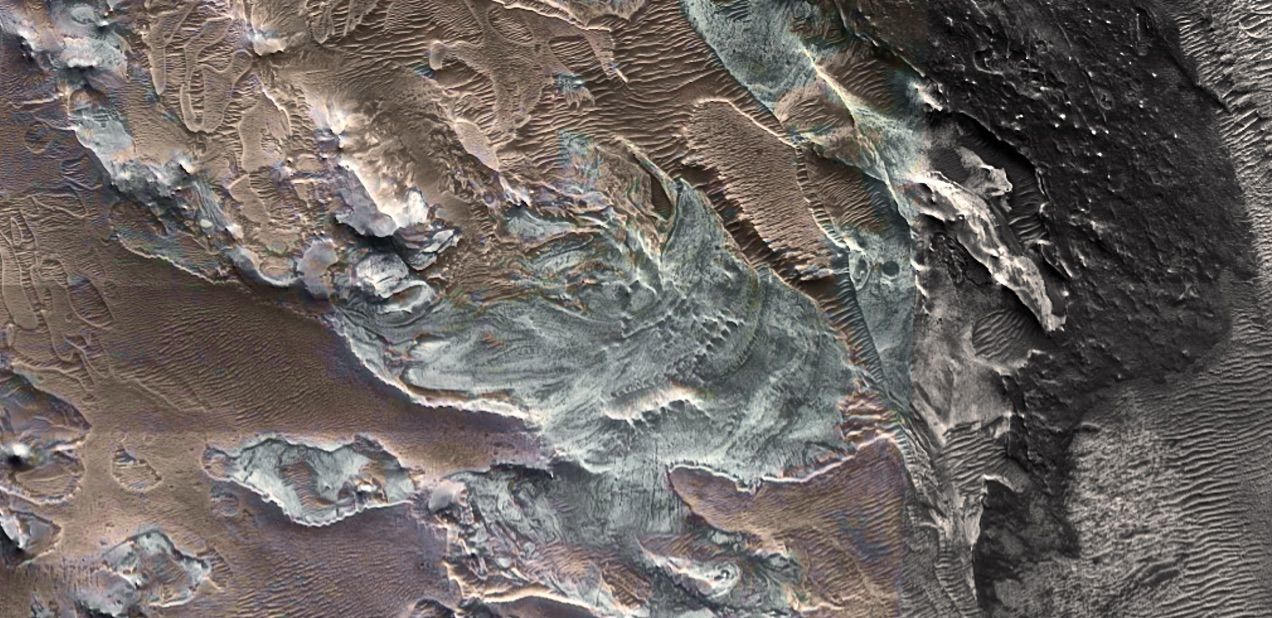
화성 적도 근처의 잔해 빙하. (NASA MRO HiRISE 및 CRISM 가색 복합물). 신용: 파스칼 리
화성의 얕은 깊이와 저위도에서 얼음을 보존하는 것은 과학 연구와 인간 탐사 모두에 중요한 의미를 가질 것입니다.
텍사스 주 우드랜즈에서 열린 제54회 행성 및 달 과학 회의에서 과학자들은 적도 근처에 위치한 빙하의 획기적인 발견을 발표했습니다.[{” attribute=””>Mars. This glacier is located in Eastern Noctis Labyrinthus at coordinates 7° 33′ S, 93° 14′ W, and its discovery is a significant indication of the presence of surface water ice on Mars in recent history, even close to the equator. This finding also suggests the potential existence of ice at shallow depths in the region, which could have crucial implications for future human exploration.
The surface feature identified as a “relict glacier” is one of many light-toned deposits (LTDs) found in the region. Typically, LTDs consist mainly of light-colored sulfate salts, but this deposit also shows many of the features of a glacier, including crevasse fields and moraine bands. The glacier is estimated to be 6 kilometers long and up to 4 kilometers wide, with a surface elevation ranging from +1.3 to +1.7 kilometers. This discovery suggests that Mars’ recent history may have been more watery than previously thought, which could have implications for understanding the planet’s habitability.
“What we’ve found is not ice, but a salt deposit with the detailed morphologic features of a glacier. What we think happened here is that salt formed on top of a glacier while preserving the shape of the ice below, down to details like crevasse fields and moraine bands,” said Dr. Pascal Lee, a planetary scientist with the SETI Institute and the Mars Institute, and the lead author of the study.
The presence of volcanic materials blanketing the region hints of how the sulfate salts might have formed and preserved a glacier’s imprint underneath. When freshly erupted pyroclastic materials (mixtures of volcanic ash, pumice, and hot lava blocks) come in contact with water ice, sulfate salts like the ones commonly making up Mars’ light-toned deposits may form and build up into a hardened, crusty salt layer.

Interpretation of the “Relict Glacier’s” features. Credit: Pascal Lee
“This region of Mars has a history of volcanic activity. And where some of the volcanic materials came in contact with glacier ice, chemical reactions would have taken place at the boundary between the two to form a hardened layer of sulfate salts,” explains Sourabh Shubham, a graduate student at the University of Maryland’s Department of Geology, and a co-author of the study. “This is the most likely explanation for the hydrated and hydroxylated sulfates we observe in this light-toned deposit.”
Over time, with erosion removing the blanketing volcanic materials, a crusty layer of sulfates mirroring the glacier ice underneath became exposed, which would explain how a salt deposit is now visible, presenting features unique to glaciers such as crevasses and moraine bands.
“Glaciers often present distinctive types of features, including marginal, splaying, and tic-tac-toe crevasse fields, and also thrust moraine bands and foliation. We are seeing analogous features in this light-toned deposit, in form, location, and scale. It’s very intriguing,” said John Schutt, a geologist at the Mars Institute, experienced icefield guide in the Arctic and Antarctica, and a co-author of this study.
The glacier’s fine-scale features, its associated sulfate salts deposit, and the overlying volcanic materials are all very sparsely cratered by impacts and must be geologically young, likely Amazonian in age, the latest geologic period which includes modern Mars. “We’ve known about glacial activity on Mars at many locations, including near the equator in the more distant past. And we’ve known about recent glacial activity on Mars, but so far, only at higher latitudes. A relatively young relict glacier in this location tells us that Mars experienced surface ice in recent times, even near the equator, which is new,” said Lee.
It remains to be seen whether water ice might still be preserved underneath the light-toned deposit or if it has disappeared entirely. “Water ice is, at present, not stable at the very surface of Mars near the equator at these elevations. So, it’s not surprising that we’re not detecting any water ice at the surface. It is possible that all the glacier’s water ice has sublimated away by now. But there’s also a chance that some of it might still be protected at shallow depth under the sulfate salts.”
The study draws an analogy with the ancient ice islands on salt lakebeds, or salars, of the Altiplano in South America. There, old glacier ice has remained protected from melting, evaporation, and sublimation underneath blankets of bright salts. Lee and his co-authors hypothesize a similar situation to explain how sulfate salts on Mars might be able to offer protection to otherwise sublimation-vulnerable ice at low latitudes on the planet.
If there is still water ice preserved at shallow depths at a low latitude on Mars, there would be implications for science and human exploration. “The desire to land humans at a location where they might be able to extract water ice from the ground has been pushing mission planners to consider higher latitude sites. But the latter environments are typically colder and more challenging for humans and robots. If there were equatorial locations where ice might be found at shallow depth, then we’d have the best of both environments: warmer conditions for human exploration and still access to ice,” said Lee.
But Lee cautions that more work still needs to be done: “We now have to determine if, and how much, water ice might actually be present in this relict glacier, and whether other light-toned deposits might also have, or have had, ice-rich substrates.”
Reference: “A Relict Glacier Near Mars’ Equator: Evidence for Recent Glaciation and Volcanism in Eastern Noctis Labyrinthus” by Pascal Lee, Sourabh Shubham and John W. Schutt, 2023, 54th Lunar and Planetary Science Conference.
Abstract: https://www.hou.usra.edu/meetings/lpsc2023/pdf/2998.pdf

김애란은 bsnewspaper.com의 필진으로 뉴스, 정치, 경제, 기술, 스포츠, 엔터테인먼트, 라이프스타일 등 다양한 분야의 소식을 다룹니다. 독자들이 중요한 이슈를 쉽게 이해할 수 있도록 명확하고 균형 잡힌 보도에 중점을 두고 있으며, 유용한 정보와 시의성 있는 내용을 전달합니다. 또한 현재의 주요 사건과 독자들의 관심사에 맞는 이야기를 알기 쉽게 풀어내는 데 힘쓰고 있습니다.