
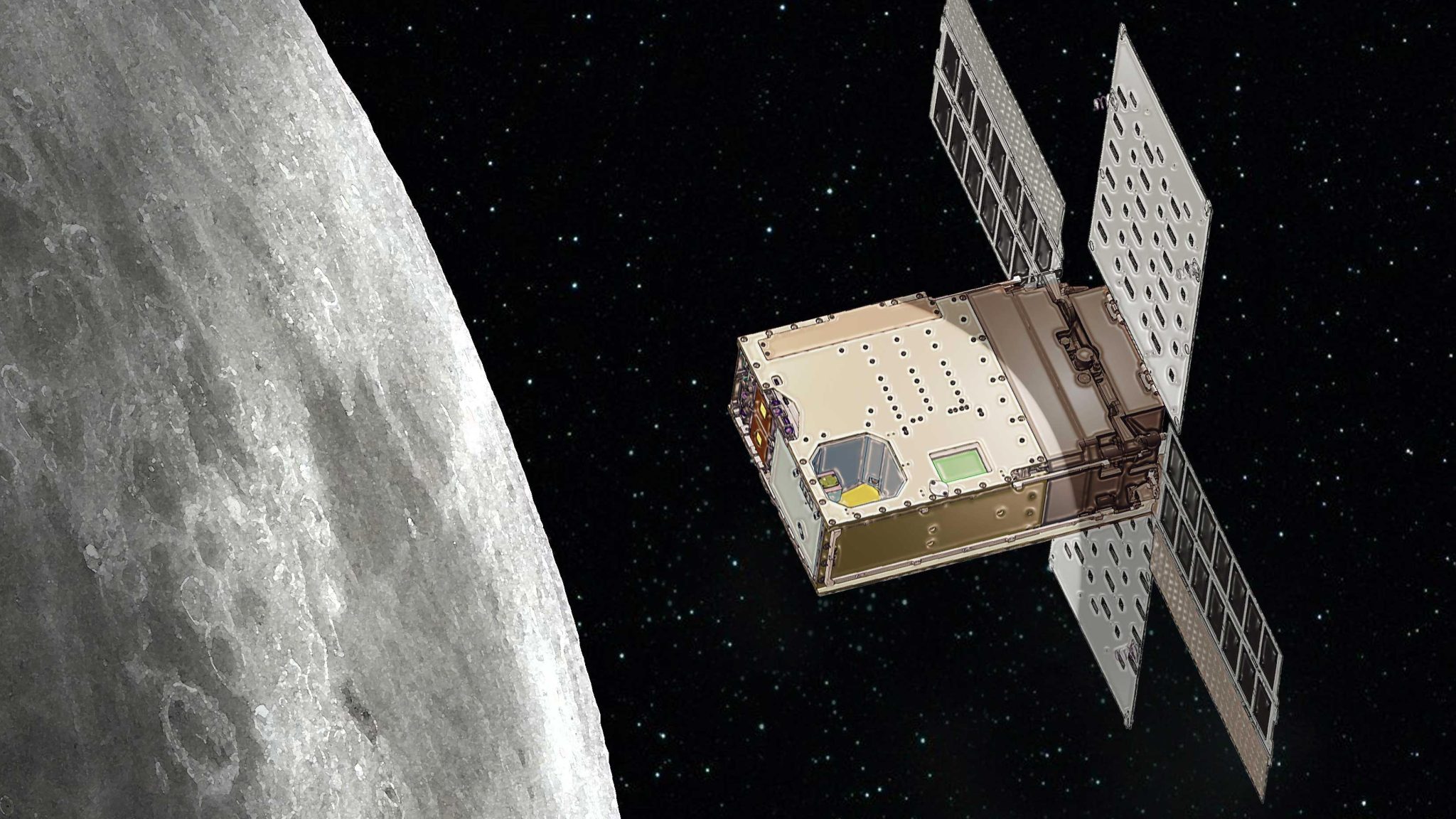
이 그림은 NASA의 달 위로 달빛 섬광의 빛을 보여줍니다. SmallSat 임무는 달의 가장 어두운 분화구에서 물 얼음을 찾기 위해 달의 남극에서 15km(9마일) 상공에서 매우 긴 궤도를 돌게 될 것입니다. 크레딧: NASA
Lunar Flashlight has communicated with mission controllers and confirmed it is healthy. About 53 minutes after launch, the small satellite, or SmallSat, was released from its dispenser to begin a four-month journey to the Moon to seek out surface water ice in permanently shadowed craters at the lunar South Pole.
“It was a beautiful launch,” said John Baker, the Lunar Flashlight project manager at NASA’s Jet Propulsion Laboratory (JPL) in Southern California. “The whole team is excited to see this small spacecraft do some big science in a few months’ time.”
While Lunar Flashlight will never return to Earth, the world hasn’t missed its last chance to see the briefcase-size spacecraft. Rendered in crisp detail, a 3D digital version of the solar-powered SmallSat has made its debut in NASA’s Eyes on the Solar System, the agency’s recently revamped visualization tool.

This illustration shows NASA’s Lunar Flashlight, with its four solar arrays deployed, shortly after launch. The small satellite, or SmallSat, will take about three months to reach its science orbit to seek out surface water ice in the darkest craters of the Moon’s South Pole. Credit: NASA/JPL-Caltech
“As soon as the Lunar Flashlight mission reached space, Eyes began tracking it, just as it will throughout the SmallSat’s entire science mission,” said Jason Craig, visualization producer at JPL. “The system uses real trajectory data from the mission, so as Lunar Flashlight’s journey unfolds, you can see exactly where the SmallSat is.”
The spacecraft’s avatar is an exact model of the real thing, down to its four solar arrays, science instrument, and thrusters. With the drag of a finger or mouse, users can change their perspective of the SmallSat and see where it is in space, whether on its long trek to lunar orbit or when it’s zooming above the lunar surface, collecting science data.
To get close to the Moon’s surface, the SmallSat will employ what’s called a near-rectilinear halo orbit – designed for energy efficiency – that will take it within just 9 miles (15 kilometers) over the lunar South Pole and 43,000 miles (70,000 kilometers) away at its farthest point. Only one other spacecraft has employed this type of orbit: NASA’s Cislunar Autonomous Positioning System Technology Operations and Navigation Experiment (CAPSTONE) mission, which launched earlier this year and can also be viewed in NASA Eyes, including as it makes its closest passes over the lunar North Pole.
Lunar Ice Science
Lunar Flashlight will use a reflectometer equipped with four lasers that emit near-infrared light in wavelengths readily absorbed by surface water ice. This is the first time that multiple colored lasers will be used to seek out ice inside these dark regions on the Moon, which haven’t seen sunlight in billions of years. Should the lasers hit bare rock or regolith (broken rock and dust), the light will reflect back to the spacecraft. But if the target absorbs the light, that would indicate the presence of water ice. The greater the absorption, the more ice there may be.
The science data collected by the mission will be compared with observations made by other lunar missions to help reveal the distribution of surface water ice on the Moon for potential use by future astronauts.
Lunar Flashlight will use a new kind of “green” propellant that is safer to transport and store than the commonly used in-space propellants such as hydrazine. In fact, the SmallSat will be the first interplanetary spacecraft to use this propellant, and one of the mission’s primary goals is to demonstrate this technology for future use. The propellant was successfully tested on a previous NASA technology demonstration mission in Earth orbit.
More About the Mission
Lunar Flashlight launched on a SpaceX Falcon 9 rocket as a rideshare with ispace’s HAKUTO-R Mission 1. Lunar Flashlight is managed for NASA by JPL, a division of Caltech in Pasadena, California. Barbara Cohen, the mission’s principal investigator, is based at NASA’s Goddard Space Flight Center in Greenbelt, Maryland. Lunar Flashlight will be operated by Georgia Tech, including graduate and undergraduate students. The Lunar Flashlight science team is distributed across multiple institutions, including Goddard, the University of California, Los Angeles, Johns Hopkins University Applied Physics Laboratory, and the University of Colorado.
The SmallSat’s propulsion system was developed by NASA’s Marshall Space Flight Center in Huntsville, Alabama, with development and integration support from Georgia Tech. NASA’s Small Business Innovation Research program funded component development from small businesses including Plasma Processes Inc. (Rubicon) for thruster development, Flight Works for pump development, and Beehive Industries (formerly Volunteer Aerospace) for specific 3D printed components. The Air Force Research Laboratory also contributed financially to the development of the Lunar Flashlight propulsion system. Lunar Flashlight is funded by the Small Spacecraft Technology program within NASA’s Space Technology Mission Directorate.

김애란은 bsnewspaper.com의 필진으로 뉴스, 정치, 경제, 기술, 스포츠, 엔터테인먼트, 라이프스타일 등 다양한 분야의 소식을 다룹니다. 독자들이 중요한 이슈를 쉽게 이해할 수 있도록 명확하고 균형 잡힌 보도에 중점을 두고 있으며, 유용한 정보와 시의성 있는 내용을 전달합니다. 또한 현재의 주요 사건과 독자들의 관심사에 맞는 이야기를 알기 쉽게 풀어내는 데 힘쓰고 있습니다.